
Library & Learning Resource Center
Believe You Can! Saber Que Se Puede!
Press enter or spacebar to select a desired language.

HOW TO CONCENTRATE GUIDE

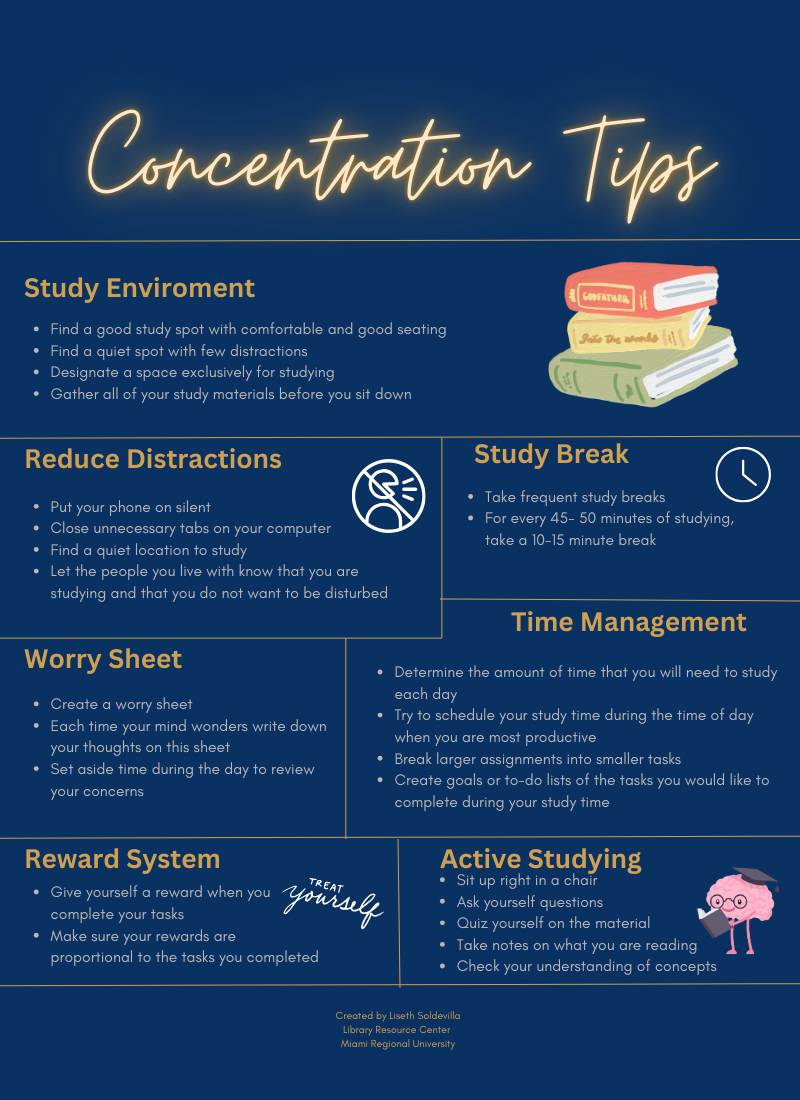
Concentration Tips

Concentration Worksheet

Self – Assessment Exercise:

Check the statements that apply to you:

  • I am easily distracted when I study.
  • My mind wonders when I read.
  • I can’t seem to find the time to study.
  • I tend to procrastinate and put off studying to do something else.
  • My mind goes blank on a test.
  • If I do not like the instructor, I lose interest and do not pay attention.
  • If the subject does not relate to my career goals, I lose interest.
  • If an assignment is too difficult, I usually do not stick with it.
  • I do not have a career goal, or a reason to study.
  • It’s hard for me to take notes and listen at the same time.
  • Others:

Possible causes for poor concentration:

Internal Factors:

  • Physical distractions – Irregular eating, sleeping, and exercise patterns,
  • depression, anxiety, chronic pain or other related health
  • and mental health issues.
  • Emotion preoccupation or distraction – Personal issues or crisis ie. relationship break-up, job loss
  • Excessive worry – Preoccupation and fear about future, failure, etc.
  • Negative self-talk – Critical, comparative or perfectionist thinking
  • Lack of career direction
  • Lack of clarity or confusion regarding course work or expectations
  • Other:

External Factors:

  • People talking
  • Noise distractions – TV, people talking, music, telephone
  • Light too dim/bright
  • Temperature too high/low
  • Time pressures
  • Social distractions – invitations, family needs, time with friends
  • Discouraging words from others
  • Lack of adequate materials or resources to complete the task
  • Physical danger or threat
  • Other:

I am most focused and alert when I __________________________________________

Concentration Techniques:

If you find your mind wandering, try some techniques to get your mind on the right track and paying attention to your study material.

“BE HERE NOW” TECHNIQUE:

  • When you notice your thoughts wandering, say to yourself, “BE HERE NOW”
  • Focus on your study or lecture and maintain your attention as long as possible.
  • When your mind wanders again, repeat, “BE HERE NOW”.
  • Each time your mind wanders, gently bring it back by repeating “BE HERE NOW”
    • Do not try to keep specific thoughts out of your mind.
  • The more you try not to think about something, the more you end up thinking about it
    • Simply recognize the thought, allow it to be and erase it from you mind by saying, “BE HERE NOW”
  • It is normal to have to do this several hundred times per week
    • With practice, you will notice that your attention becomes more focused and your wandering thoughts become less frequent
  • You may also use this technique to regain your concentration when you become distracted by an external distraction (ie. background noise)
    • Just say, “LET THEM BE OUT THERE”, and redirect your focus to your study or lecture

PRACTICE RELAXATION AND MEDITATION:

  • Learn CONTROLLED BREATHING
    • Put one hand on your upper chest and one on your stomach, the hand on your stomach moves out as you breathe in
    • Try breathing in for a count of 4 and out to a count of 4 for 4 min.
    • This technique optimizes oxygen intake, helping the brain to be alert
  • Learn PROGRESSIVE MUSCLE RELAXATION
    • Tense and relax each major muscle group (ie. feet, calves, thighs etc)
    • Tense each muscle group for 5 seconds, relax for 10-15 seconds
  • Learn MEDITATION
    •  Imagery meditation involves actively visualizing scenes that are tranquil, safe and relaxing to you
    • Choose scenes that are imagined/remembered and incorporate as many of your senses as possible (smell, taste, tactile, visual)
    • With practice, these techniques may be effectively implemented during a lecture, study period or exam.

Concentration Plan

Step 1: Define the Activity

Write one assignment or activity that you need to complete this week. For example, “write paper for psychology course.”

Step 2: Break the Activity into Smaller Tasks

Break down the assignment or activity into smaller parts to make it feel more manageable. For example, you can break your paper down into multiple parts, such as “conduct research,” “create outline,” “write paper,” etc.

Activity Tasks

Time Required

1.

2.

3.

4.

5.

Step 3: Create a Schedule

Schedule each task for a specific time. Create a plan of how you will remember to complete each task at the scheduled time (ex: set phone reminder, write it in planner, etc.)

Schedule

Reminder

Step 4: Prepare for the Activity

List how your will get ready to work on the assignment or activity, before the scheduled time.

Eliminate Distractions

List distractions you can eliminate before starting (ex: silencing phone, turning of tv, etc.)

Plan for Unavailable Distractions

Create “If, then” plans for likely distractions (ex: if my roommate comes into my room, I will tell them “I am busy. I will talk to you later.”)

Materials and Supplies

List all items you will need to complete the activity (ex: laptop, charger, book, notes, etc.)

Physical Preparation

List actions you will take to get ready for the activity (ex: sitting at desk, eating a snack before sitting down, etc.)

Step 5: List the Pros and Cons of Following This Plan

List the benefits and costs of following through with the plan you have created.

Pros

Cons