Visual Learners
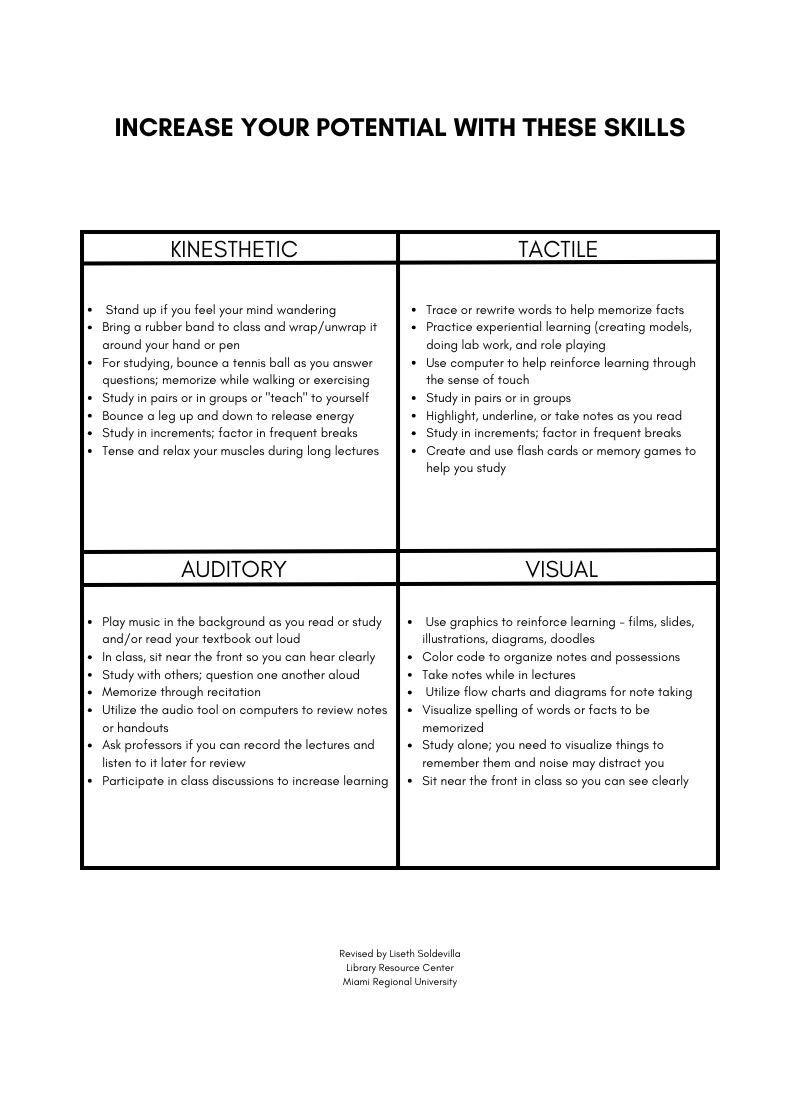
In learning skills, if your strength is Visual Learning (you have a high visual score), then by all means be sure you emphasize the use of sight on all study materials. For example, use existing and/or make charts, maps, pictures, overheads, and rewrite notes. Practice visualizing concepts and ideas or to picture spelling words in your head, for example, will help you learn. Regularly test yourself by looking at main ideas or questions and write the details or answers. Doing this frequently is an efficient way to review visually.
In thinking, Visual Learners tend to think in images or pictures. It is as if they have a video camera in their minds. They take in what they hear or read and translate it into images in their brain. When Visual Learners want to recall what he or she has learned, they simply look at the image that they have stored on their mental "picture screen". This process is much like going to the movies and then recalling what one has seen, in order to tell a friend. The memory process is taking place by reviewing the pictures from the movie and then talking about the story line to someone else. Visual Learners speak in terms of "I see, I get the picture."
In a classroom, Visual Learners find it easier when testing is conducted in a written "visual" format because this requires that visual images be made to recall information. Good Visual Learners read the black and white text and then convert the information into pictures, maps, sketches, diagrams, lists, etc. This makes storing of information and later recall easier. The Visual Learner will easily conform to most classroom standards, such as sitting quietly, writing neatly, and organizing materials well.
When choosing careers, Visual Learners should select those fields which fit their learning style: architect, designer, decorator, engineer, surgeon, and those careers which require a "vision" of the future, such as CEOs and other executive positions.
Visual learners make up around 65% of the population.
Auditory Learners
In learning skills, Auditory Learners will learn more effectively if they emphasize the use of their sense of hearing to learn ideas and concepts. For example, Auditory Learners will benefit more if they sit in the front of the class so they can hear lectures clearly. They more readily join discussion groups so they can hear ideas and concepts verbalized by themselves and others. They practice lectures by themselves or test themselves by reciting details aloud after looking only at a main idea.
In thinking, Auditory Learners do not emphasize make pictures in their minds, as do visual learners, but rather filter incoming information through their listening and repeating aloud. Auditory Learners tell wonderful stories and solve problems by "talking" about them.
In the classroom, the Auditory Learner learns by listening and can more easily repeat statements back to the teacher. The Auditory Learner likes class discussions but can become easily distracted by noise. Of the three styles, the Auditory Learner is the most talkative but has more difficulty writing.
In careers, the excellent listening skills of this type of learner are what make great musicians, disc jockeys, psychologists, etc. Speech patterns will represent exactly how the Auditory Learner thinks, i.e., "I hear ya, that clicks, that sounds right, that rings a bell" etc.
Auditory learners make up about 30% of the population.
Tactile Learners
In learning skills, Tactile Learners benefit if they emphasize the use of their sense of touch in learning. For example, they should rewrite notes frequently or make questions from main ideas and regularly try to write the answers from memory. Putting this information on notecards is an easy way to organize main ideas and details while using tactile skills. It is also easy to quiz themselves and to touch what they need to learn and remember. They prefer to study with a pen or pencil in hand and write things down. They benefit from drawing pictures and diagrams in their notes. Tactile Learners prefer to learn through the body or feelings. If they can touch and feel whatever they are learning about, Tactile Learners will process and remember the information quite well.
In thinking, Tactile Learners do not have the internal pictures of neatness and organization that visual learners make so easily in their minds. This is one of the reasons that Tactile Learners have a more difficult time demonstrating what they know in a traditional classroom. Tactile Learners do not usually make pictures in their minds. If they do not make pictures, it follows that there are no pictures to either keep neat, or to "mess up." Therefore, it is normal for them not to be organized. A sense of time is also quite difficult for the student who prefers to learn tactilely. Often, there is little projection of consequences of actions, simply because this learner does not "see" out into the future. They are better at understanding the present moment.
In the classroom, these students are usually quite restless, have more difficulty paying attention, and can't seem to get " focused " (a visual term). These learners like to speak about learning in terms of feelings and say things like "I feel" or "I'd like to get a better handle on this information." Tactile Learners excel in a classroom where ideas are "acted out" and where they can choose assignments that allow them to build things and get their hands involved in learning.
In careers, Tactile Learners prefer athletics, building, construction, dancing, etc.; essentially any work that involves using the senses.
Tactile learners make up around 2.5% of the population.
Kinesthetic Learners
Kinesthetic Learners benefit if they use their body in learning. For example, some Kinesthetic Learners walk while studying notes and find that it improves learning. Using some sort of movement when memorizing is another way to increase learning for Kinesthetic Learners.
In thinking, Kinesthetic Learners are better able to think and process information while doing something physical.
In careers, Kinesthetic Learners also prefer careers in athletics, building, construction, dancing, etc., any work that involves the body and movement.
Kinesthetic learners make up around 2.5% of the population.
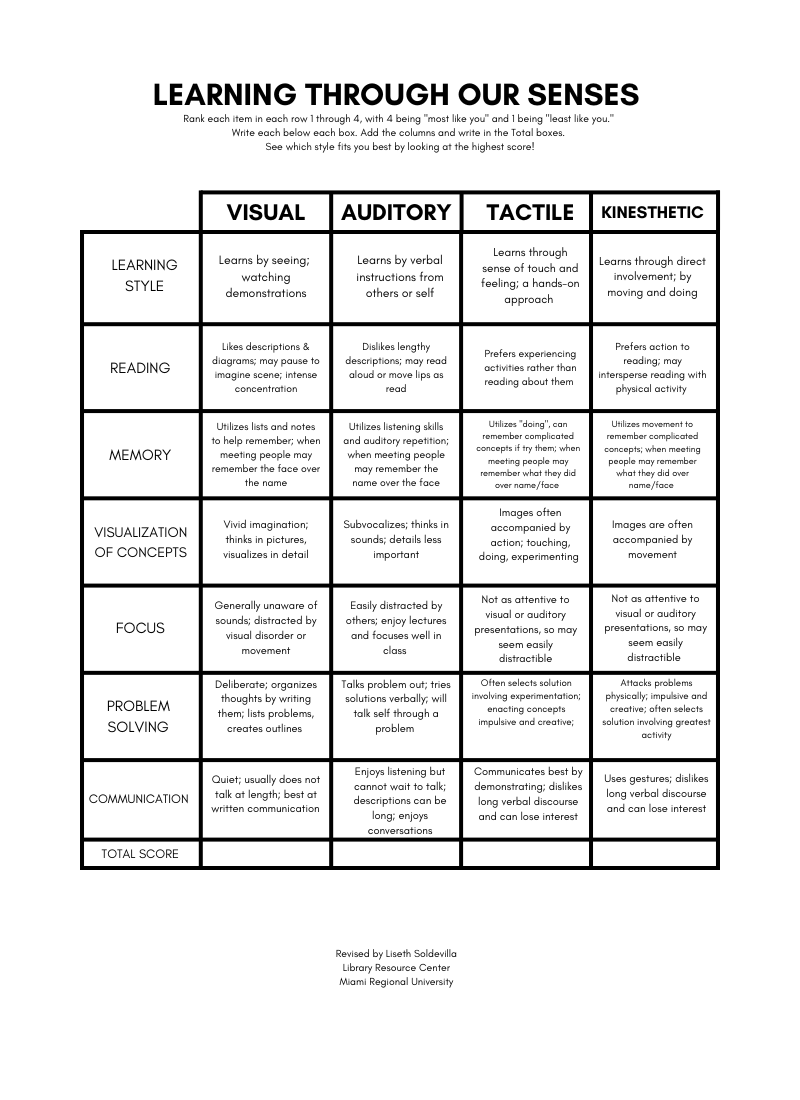
To learn your studying habit, take the following inventory